


Be Wellness™
Be. 100% Multivitamin
Be. 100% Multivitamin
WHAT IT DOES
Couldn't load pickup availability

Order in 5h 41m · Ships today
Free delivery across India on orders over ₹1,899

Free gift on every order over ₹1,899
Added to your bag automatically at checkout.

319 Be. Iconic Points
Redeem points against future orders. Members save 10% more.
 Licensed
 Certified
 Verified
 Gluten Free


Why this exists
Why this exists
More than half of Indian adults are nutritionally deficient. Most do not know it.
This is not a marketing line. It is the published reality. Around 54% of Indians are iron deficient. 37% are folate deficient. Up to 61% are deficient in Vitamin D (Proceedings of the Nutrition Society, 2021). The everyday consequences are familiar but rarely linked back to the cause: afternoon fatigue, weaker immunity, slower recovery from illness, brittle hair and nails, lower mood, dullness in the skin.
Diet alone, even a careful one, struggles to bridge these gaps. Indian food traditions are rich in many things, but they were not designed around the demands of urban work schedules, processed-food substitution, screen-heavy days, and indoor lifestyles that quietly reduce vitamin D production in the skin. A good multivitamin is not a luxury for the wellness-curious. It is a foundation for the rest of your body's systems to do their job.
Be Wellness Multivitamin is built for exactly this. 17 essential vitamins and minerals in one daily tablet, dosed not at the rounded-down levels common in generic multivitamins, but at the clinically meaningful levels research links to actually correcting deficiency. One tablet, after breakfast. The simplest health habit you can build, and the one with the broadest reach across how your body functions.
Description
Description
Full Ingredient List
Full Ingredient List


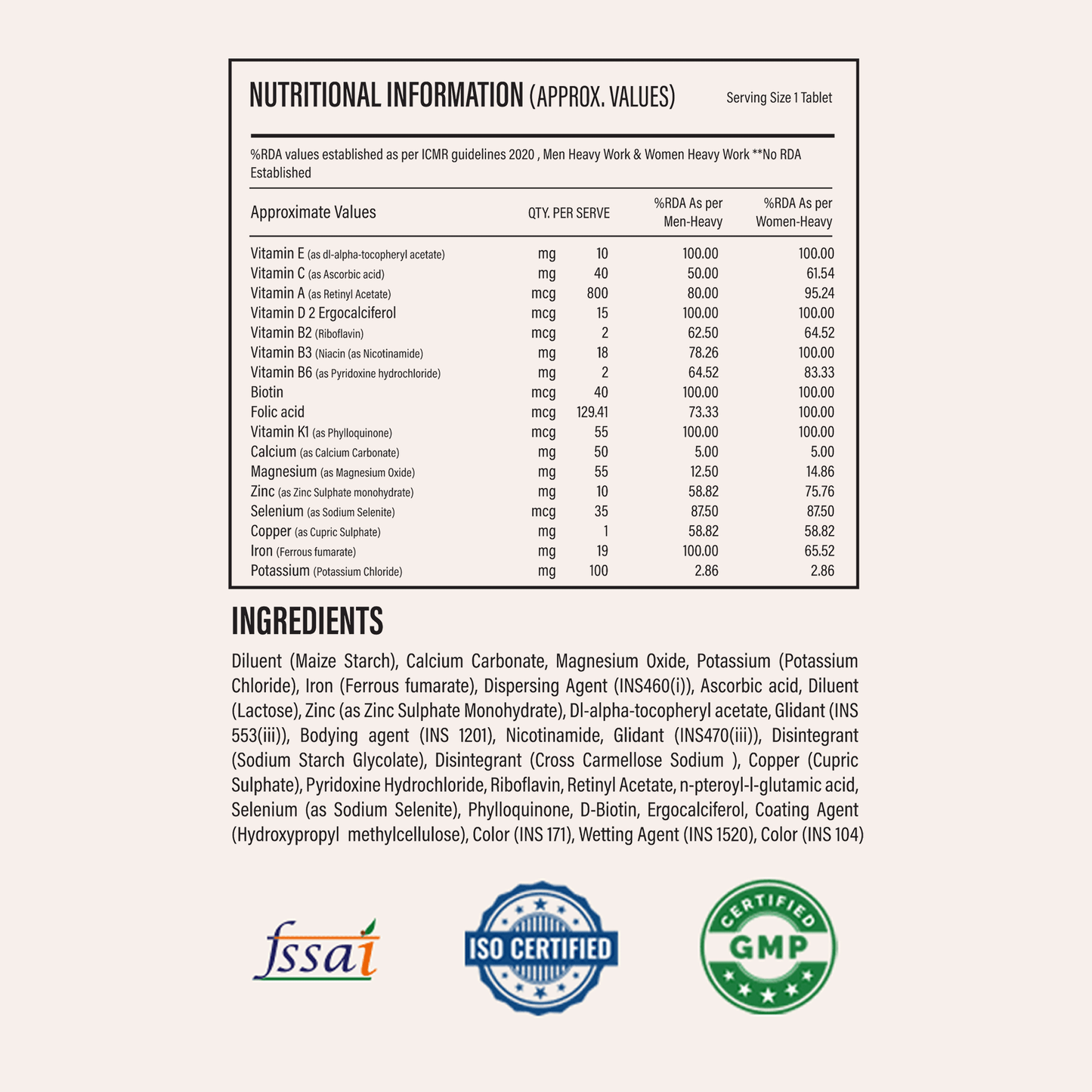
What's inside and why
Iron (Ferrous fumarate)
Anemia risk and energy Energy + Blood healthIron (Ferrous fumarate)
Anemia risk and energy Energy + Blood healthVitamin C (Ascorbic acid)
Immunity and iron absorption Immunity + SkinVitamin C (Ascorbic acid)
Immunity and iron absorption Immunity + SkinVitamin D2 (Ergocalciferol)
Immunity and bone foundation Immunity + BoneVitamin D2 (Ergocalciferol)
Immunity and bone foundation Immunity + BoneMagnesium (Magnesium Oxide)
Energy metabolism Energy + MuscleMagnesium (Magnesium Oxide)
Energy metabolism Energy + MuscleZinc (Zinc Sulphate monohydrate)
Immunity, skin, and hormonal balance Immunity + SkinZinc (Zinc Sulphate monohydrate)
Immunity, skin, and hormonal balance Immunity + SkinVitamin A (Retinyl Acetate)
Vision, immunity, and skin Immunity + Skin + EyeVitamin A (Retinyl Acetate)
Vision, immunity, and skin Immunity + Skin + EyeVitamin E (dl-alpha-tocopheryl acetate)
Skin barrier and antioxidant Skin + ImmunityVitamin E (dl-alpha-tocopheryl acetate)
Skin barrier and antioxidant Skin + ImmunitySelenium (Sodium Selenite)
Antioxidant and thyroid support Immunity + Antioxidant defenceSelenium (Sodium Selenite)
Antioxidant and thyroid support Immunity + Antioxidant defencePotassium (Potassium Chloride)
Electrolyte balance Energy + HeartPotassium (Potassium Chloride)
Electrolyte balance Energy + HeartFolic acid (Vitamin B9)
Blood health and homocysteine balance Blood + Heart + MaternalFolic acid (Vitamin B9)
Blood health and homocysteine balance Blood + Heart + MaternalBiotin (D-Biotin, Vitamin B7)
Hair, skin, and nails Hair + Nails + SkinBiotin (D-Biotin, Vitamin B7)
Hair, skin, and nails Hair + Nails + SkinVitamin B2 (Riboflavin)
Energy metabolism cofactor EnergyVitamin B2 (Riboflavin)
Energy metabolism cofactor EnergyVitamin B3 (Niacin, as Nicotinamide)
Energy metabolism and skin Energy + SkinVitamin B3 (Niacin, as Nicotinamide)
Energy metabolism and skin Energy + SkinVitamin B6 (Pyridoxine hydrochloride)
Energy and neurotransmitter synthesis Energy + BrainVitamin B6 (Pyridoxine hydrochloride)
Energy and neurotransmitter synthesis Energy + BrainCalcium (Calcium Carbonate)
Bone health foundation BoneCalcium (Calcium Carbonate)
Bone health foundation BoneVitamin K1 (Phylloquinone)
Calcium routing Bone + HeartVitamin K1 (Phylloquinone)
Calcium routing Bone + HeartCopper (Cupric Sulphate)
Collagen and zinc balance Skin + HairCopper (Cupric Sulphate)
Collagen and zinc balance Skin + Hair‘How it works together’ — Synergy
17 ingredients. One tablet. A formula where nutrients work in pairs.
Vitamins and minerals do not work in isolation. They work in pairs and triads, and including the right combinations in one tablet is what separates a working multivitamin from a sprinkled-in token of ingredients.
Vitamin C and Iron travel together. Vitamin C enhances non-heme iron absorption, which is why correcting iron deficiency works better when both are present in the same dose (Nutrients, 2021). Vitamin D, Calcium, and Vitamin K work as a triad for bone health: Vitamin D enables calcium absorption, Vitamin K directs calcium into bone rather than soft tissue. Zinc and Vitamin A pair up for both immunity and skin: Zinc is needed for the body to actually transport Vitamin A.
Magnesium activates Vitamin D into its usable form. The B-complex vitamins (B2, B3, B6, folate, biotin) run the body's energy-metabolism pathway together, which is why a B-complex shortfall shows up as daytime fatigue. Zinc and Copper are dosed in balance, because high zinc alone depletes copper. None of these pairings are luxury features. They are the difference between a multivitamin that genuinely works and a tablet that delivers numbers without effect.
The daily practice
One tablet a day
Same time
Pair with food
Stay consistent
What to expect.
The early signals
The cumulative shift
The compounding
The complete daily multivitamin
 17 essential vitamins and minerals
 8 to 13, often skips trace minerals
19 mg Ferrous fumarate (meaningful for anemia risk)
Often 5 mg or omitted
40 mg (immunity and iron absorption)
10 to 30 mg
55 mg (energy metabolism)
Often omitted or under-dosed
C+Iron, D+Ca+K, Zn+VitA, Mg+VitD intentionally combined
Random ingredient list
15 mcg D2, plant-derived (vegetarian-suitable)
Varies; sometimes omitted
Both included at dosed levels
Often missing
Iron, D, folate explicitly addressed
Generic global formula
None
Common
None. Every dose disclosed
Common
Yes
Varies
8 to 13, often skips trace minerals
19 mg Ferrous fumarate (meaningful for anemia risk)
Often 5 mg or omitted
40 mg (immunity and iron absorption)
10 to 30 mg
55 mg (energy metabolism)
Often omitted or under-dosed
C+Iron, D+Ca+K, Zn+VitA, Mg+VitD intentionally combined
Random ingredient list
15 mcg D2, plant-derived (vegetarian-suitable)
Varies; sometimes omitted
Both included at dosed levels
Often missing
Iron, D, folate explicitly addressed
Generic global formula
None
Common
None. Every dose disclosed
Common
Yes
Varies
Non-Negotiable Standards
Credibility is engineered. We reject industry minimums. Every formulation stands on deliberate logic and absolute scientific accountability.
Research-Backed Ingredients
Full Ingredient Disclosure
Effective Dosages
Certified Manufacturing
Pair it with 100% multivitamin
your routine

Be. Handsome Hair & Beard Support (For Him)
A biotin-led hair and beard support formula for men.

Be. Sexy Japanese Marine Collagen
Type I and III. 8.44 g of low-molecular-weight marine

Be.
On
DND
Nightly
Reset
A natural, non-habit-forming sleep supplement
Questions, answered.
Can't find what you need? Write to care@bewellness.co and we'll answer within a day.
Who should take a daily multivitamin?
Most adult Indians can benefit. Published research suggests around 54% of Indians are iron deficient, 37% folate deficient, and up to 61% vitamin D deficient. Modern diets, even careful ones, struggle to bridge these gaps. A daily multivitamin is the simplest, broadest-reaching health habit you can build. If you are pregnant, breastfeeding, on medication, or managing a health condition, check with your doctor before starting any supplement.
Is this multivitamin for men or women?
Both. Be Wellness Multivitamin is gender-agnostic and built for adults of any gender. The nutrient gaps in modern Indian diets (iron, vitamin D, folate, magnesium, zinc) affect men and women alike. Women planning pregnancy, women with heavier menstrual cycles, and post-menopausal women may have higher iron and calcium needs respectively, which makes a comprehensive multivitamin even more useful as a foundation.
What time of day should I take it, and with or without food?
Take one tablet a day, preferably after breakfast, with a glass of water. Food helps the fat-soluble vitamins (A, D, E, K) absorb properly, and reduces the chance of mild stomach discomfort from the iron. Same time every day is more important than the exact time.
What is the difference between Vitamin D2 and Vitamin D3, and which is in this product?
Vitamin D2 (ergocalciferol) is plant-derived; Vitamin D3 (cholecalciferol) is the animal-derived form (typically from lanolin in sheep wool or fish oil). This formula uses Vitamin D2 at 15 mcg, which keeps the vitamin D source vegetarian-suitable. Both forms raise vitamin D levels, with D3 showing slightly higher potency in some studies. The 15 mcg D2 dose meets full daily ICMR requirements and addresses the most widespread vitamin deficiency in the Indian population.
Can I take this multivitamin alongside other Be Wellness products?
Yes, the multivitamin is designed as the foundation of a supplement stack. Be Wellness Alpha, Creatine+, Protein WPI, Yeast Protein, and Japanese Marine Collagen all complement a daily multivitamin without significant overlap. If you take iron from another source, or zinc from another source, you may want to space them apart through the day to avoid stacking the same nutrient.
Are there any side effects of taking a daily multivitamin?
Multivitamins at well-formulated doses are generally well tolerated. The most common minor effects are mild stomach upset from iron in some people (taking after food reduces this) and slightly darker stool from iron (this is harmless). Avoid exceeding the recommended single tablet per day. If you are pregnant, breastfeeding, on medication, or managing a kidney or liver condition, consult your doctor first.
How long until I see and feel the difference?
Most people notice subtle energy and focus shifts within the first 1 to 2 weeks as B-vitamins, mgnesium, and iron begin to support metabolism. Skin, hair, and immunity benefits typically build over weeks 4 to 6. Deeper outcomes such as iron-deficiency correction on bloodwork take 8 to 12 weeks of consistent daily use. Consistency matters more than dose; daily, not perfecta.
Is this multivitamin vegetarian or vegan?
Vegetarian, yes. Vegan, no. The formula uses plant-derived Vitamin D2 (Ergocalciferol) rather than animal-derived D3, which keeps the vitamin source vegetarian. However, the tablet includes lactose as a diluent (an excipient that helps the active ingredients press into a stable tablet), so the product contains milk and is not vegan. The allergen panel on the label declares this clearly.


