


Be Wellness™
Be Wellness x Shivohaam Yeast Protein
Be Wellness x Shivohaam Yeast Protein
WHAT IT DOES
Couldn't load pickup availability

Order in 5h 41m · Ships today
Free delivery across India on orders over ₹1,899

Free gift on every order over ₹1,899
Added to your bag automatically at checkout.

319 Be. Iconic Points
Redeem points against future orders. Members save 10% more.
 Licensed
 Certified
 Verified
 Gluten Free


Why this exists
Why this exists
Most vegan proteins do not actually work like whey.
This is the awkward truth at the heart of the vegan protein category. Pea and rice blends, even at 25 g of protein per scoop, deliver a smaller muscle protein synthesis response than whey. Not by a little. By 30 to 40 percent. The reason is leucine: the single amino acid that triggers your muscles to actually build new tissue. Pea and rice are typically short on it. Whey is rich in it. Most vegan proteins on the shelf, including the ones marketed for gym use, never clear the 2.5 g leucine threshold that the science says you need on every serving to get a whey-equivalent result.
This is built differently. The base is a single, complete protein, not a blend: pure yeast protein from food-grade Saccharomyces cerevisiae, fermented (not extracted from a crop), with the highest digestibility score of any vegan protein commercially available. A 2022 trial published in the American Journal of Clinical Nutrition compared yeast protein to milk protein in 24 healthy young men and found the muscle protein synthesis response was statistically comparable.
Then we close the leucine gap. Every sachet includes 1 g of free fermented L-leucine, dose-titrated to push the total leucine past the 2.5 g mTOR threshold on every serving. Same full supporting stack as our whey isolate: taurine, magnesium glycinate, DigeZyme® enzymes, zinc, piperine. No dairy. No animal inputs. No leucine gap. One sachet a day, tear, mix, drink.
Description
Description
Be Wellness Yeast Protein is a pure yeast protein, engineered to match whey isolate on muscle protein synthesis. Not a pea/rice blend, not a multi-source blend. A single, complete protein source, delivered in individually wrapped 36 g sachets for portion control, freshness, and travel. Eight ingredients in every sachet: 31 g of food-grade fermented yeast protein delivering 25 g of complete protein at a DIAAS of 0.85, plus 1 g of free fermented L-leucine to push every serving above the 2.5 g mTOR threshold that pea and rice blends fall short of. The same supporting stack as our whey isolate product: 1.59 g taurine, 286 mg magnesium glycinate, 53 mg DigeZyme® vegan-grade 5-enzyme blend, 16 mg zinc gluconate, 5 mg piperine. Sweetened with stevia, no artificial sweeteners, no animal inputs, no dairy, no soy, no gluten. One sachet a day, post-training or as a daily protein top-up.
Full Ingredient List
Full Ingredient List


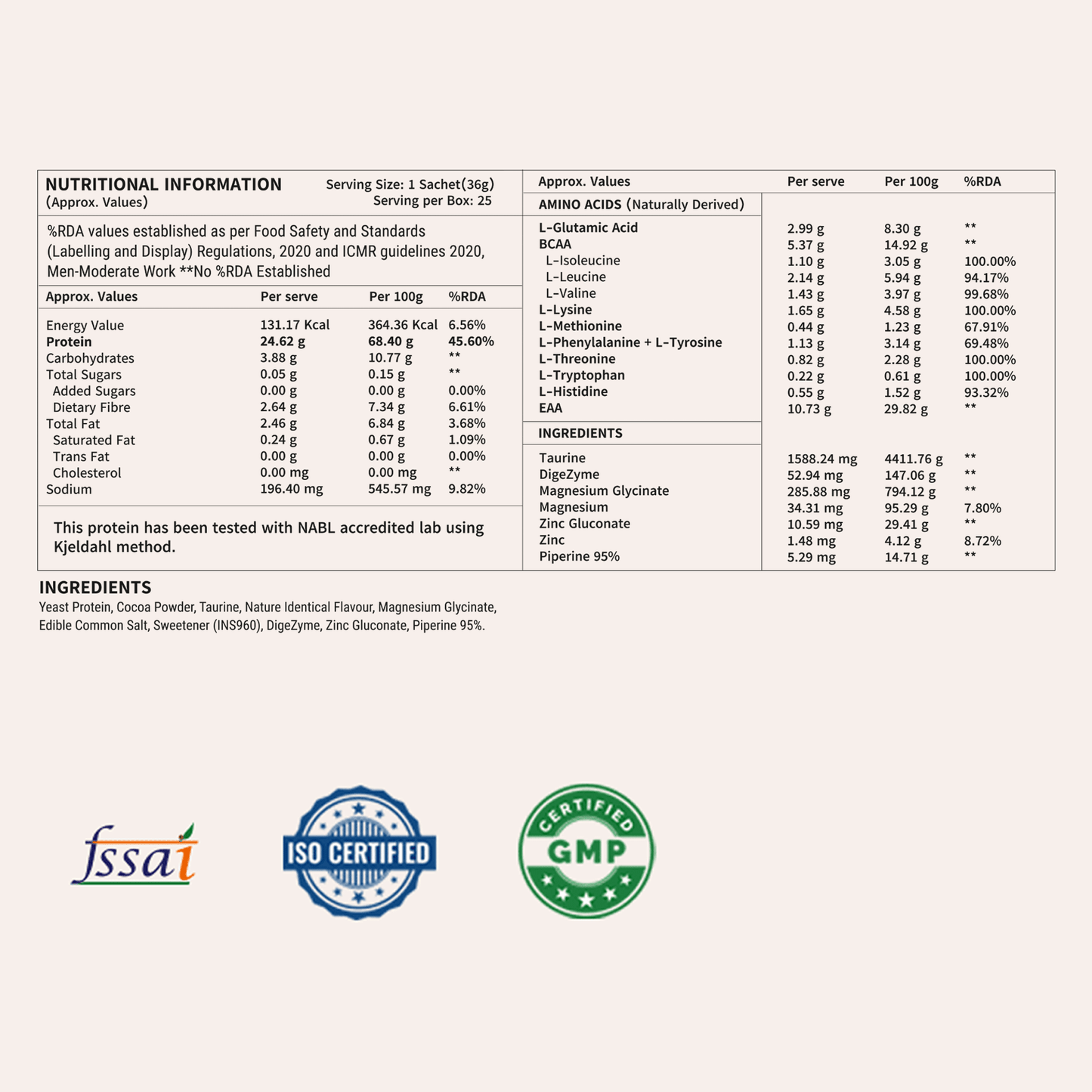
What's inside and why
Yeast Protein (Saccharomyces cerevisiae)
Fermented food-grade, single-source BUILD. Block 01Yeast Protein (Saccharomyces cerevisiae)
Fermented food-grade, single-source BUILD. Block 01Free L-Leucine (fermented)
Vegan, fermentation-derived TRIGGER. Block 02Free L-Leucine (fermented)
Vegan, fermentation-derived TRIGGER. Block 02Taurine
Sulfur amino acid (fermentation-derived) RECOVER. Block 03Taurine
Sulfur amino acid (fermentation-derived) RECOVER. Block 03Magnesium Glycinate
Chelated, high-bioavailability RECOVER. Block 03Magnesium Glycinate
Chelated, high-bioavailability RECOVER. Block 03DigeZyme® (vegan-grade)
Five-enzyme blend DIGEST. Block 04DigeZyme® (vegan-grade)
Five-enzyme blend DIGEST. Block 04Zinc Gluconate
Essential mineral ABSORB. Block 05Zinc Gluconate
Essential mineral ABSORB. Block 05Piperine (95%)
Standardised black pepper extract ABSORB. Block 05Piperine (95%)
Standardised black pepper extract ABSORB. Block 05Cocoa + Dark Chocolate + Stevia + Salt
Vegan flavour system Flavour matrixCocoa + Dark Chocolate + Stevia + Salt
Vegan flavour system Flavour matrix‘How it works together’ — Synergy
Five blocks. One sachet. A yeast protein engineered like a dairy one.
The architectural insight of this formula is that we treat the leucine gap between yeast and whey as a known engineering problem and solve it directly. The yeast protein supplies the bulk amino acid load (25 g of complete protein with all nine essentials), and the 1 g of free leucine ensures every serving clears the mTOR trigger threshold. This is the step that separates a yeast protein that actually builds muscle from a pea/rice blend that hopes you ingest enough to overcome the gap.
DigeZyme® then plays a uniquely important role here. Yeast cell wall mannans and beta-glucans are non-digestible if not enzymatically broken down. Without DigeZyme®, an estimated 10 to 15 percent of the protein dose would pass through your gut unused. Taurine and magnesium glycinate support recovery in the same way as our whey isolate. Zinc and piperine close the absorption layer, which matters more here than in the dairy version because vegan and vegetarian eaters absorb less zinc from food.
Build, trigger, recover, digest, absorb. The result is a yeast protein that, taken with appropriate resistance training, produces lean mass and strength outcomes comparable to whey isolate. With a tenth of the carbon footprint of dairy, no animal inputs, and a gentle digestive feel that most users notice from the first sachet.
The daily practice
Tear one sachet open
On rest days
Pair with food
Stay consistent
What to expect.
The clean feeling
The build
The convergence
The yeast protein engineered like a dairy one
 Pure yeast (single-source, DIAAS 0.85)
 Pea + rice blend, DIAAS ~0.65
25 g (complete amino profile)
20 to 25 g (incomplete profile)
~2.7 g (above mTOR threshold)
~1.5 to 1.8 g (below threshold)
1 g free fermented L-leucine
Rarely included
DigeZyme® 5-enzyme blend (vegan-grade)
Rarely included
286 mg glycinate (chelated)
Almost never included
16 mg gluconate (Schedule I)
Rarely included
5 mg standardised piperine
Rarely included
None. Taurine and leucine fermentation-derived
Sometimes (verify per brand)
Free of all four
Often soy or gluten cross-contamination
~1/10 of dairy whey
Lower than dairy, higher than yeast
None. Every dose disclosed
Common
Yes
Varies
Pea + rice blend, DIAAS ~0.65
25 g (complete amino profile)
20 to 25 g (incomplete profile)
~2.7 g (above mTOR threshold)
~1.5 to 1.8 g (below threshold)
1 g free fermented L-leucine
Rarely included
DigeZyme® 5-enzyme blend (vegan-grade)
Rarely included
286 mg glycinate (chelated)
Almost never included
16 mg gluconate (Schedule I)
Rarely included
5 mg standardised piperine
Rarely included
None. Taurine and leucine fermentation-derived
Sometimes (verify per brand)
Free of all four
Often soy or gluten cross-contamination
~1/10 of dairy whey
Lower than dairy, higher than yeast
None. Every dose disclosed
Common
Yes
Varies
Non-Negotiable Standards
Credibility is engineered. We reject industry minimums. Every formulation stands on deliberate logic and absolute scientific accountability.
Research-Backed Ingredients
Full Ingredient Disclosure
Effective Dosages
Certified Manufacturing
Pair it with
your routine

Be. 100% Multivitamin
17 essential vitamins and minerals in one daily tablet.

Be.
On
DND
Nightly
Reset
A natural, non-habit-forming sleep supplement

Be.
Alpha
Testosterone
Booster
A natural testosterone booster for men performance
Questions, answered.
Can't find what you need? Write to care@bewellness.co and we'll answer within a day.
What is yeast protein, and is it safe?
Yeast protein is a complete protein produced by fermenting food-grade Saccharomyces cerevisiae, the same family of yeast used in bread and brewing for thousands of years. This formula uses pure yeast protein as a single source, not a pea/rice blend. It contains all nine essential amino acids, has a digestibility score (DIAAS) of 0.85, which is higher than any other commercially available vegan protein, and is naturally rich in B vitamins and beta-glucans. It is widely consumed in food applications globally and is generally well tolerated.
How does this compare to whey protein?
A 2022 trial in the American Journal of Clinical Nutrition compared yeast protein to milk protein in 24 healthy young men and found a statistically comparable muscle protein synthesis response over 5 hours. With this formula's additional 1 g of free fermented L-leucine clearing the 2.5 g mTOR threshold on every serving, the muscle-building signal is brought to whey-equivalent levels. The practical difference: same protein outcome, no dairy, no animal inputs, much lower carbon footprint.
Why do most vegan proteins not work as well as whey?
Most vegan proteins (pea and rice blends in particular) deliver less leucine per serving than whey. Leucine is the amino acid that triggers muscle protein synthesis, and the threshold for an optimal response is around 2.5 g per serving. Typical pea/rice blends deliver 1.5 to 1.8 g, below the threshold, which means a 30 to 40 percent smaller muscle-building response than whey. This formula closes that gap with 1 g of added free leucine on every scoop.
Is this product vegan and dairy-free?
Yes. Be Wellness Yeast Protein is 100% vegan, dairy-free, lactose-free, soy-free, and gluten-free. The leucine and taurine are fermentation-derived, not animal-derived. The zinc gluconate is FSSAI Schedule I compliant and vegan-suitable. No animal inputs anywhere in the formula.
What does it taste like?
Cocoa, sweetened with stevia. The flavour system uses Dutched cocoa powder and dark chocolate concentrate at a slightly higher load than our whey isolate, because yeast protein has more umami, earthy natural notes that benefit from richer flavour scaffolding. No artificial sweeteners, no artificial colours, no proprietary blends. Most users report the taste as comparable to a clean chocolate protein shake.
Will this cause bloating?
Less than most vegan proteins. Yeast cell walls contain mannans and beta-glucans that, if not broken down, can cause bloat. This formula includes a vegan-grade DigeZyme® 5-enzyme blend specifically to break those cell walls down and free up the amino acids. The most common feedback from users moving from a pea or rice blend is that this one sits noticeably lighter in the gut.
Is this good for muscle gain?
Yes. The Pinckaers 2022 trial established yeast protein as anabolically comparable to milk protein for muscle protein synthesis. The 1 g of added free leucine ensures every serving clears the mTOR threshold, which is what other vegan proteins typically miss. Pair one sachet a day with strength training 3 to 5 times a week and a daily protein target of 1.6 to 2.2 g per kg of bodyweight.
How is the leucine in this product sourced?
The leucine is fermentation-derived, not animal-derived or hair-derived. It is produced by industrial fermentation of corn or beet sugar feedstocks, the same process used to produce most modern amino acid supplements. This makes the entire formula vegan-compliant, including for users with religious or ethical sensitivities about hair-derived or animal-derived ingredients.


